
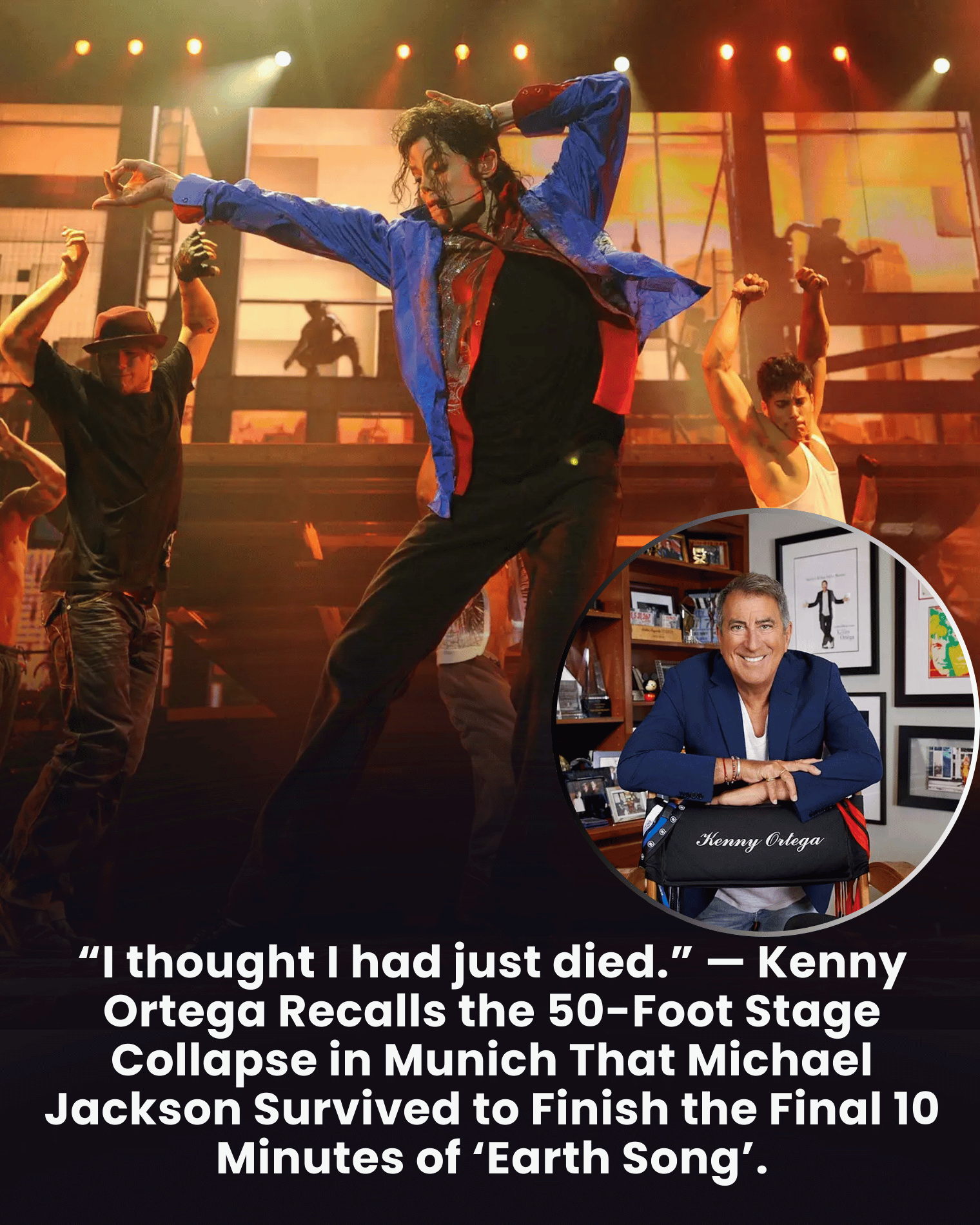
The night of the MJ & Friends concert in Munich was supposed to be a celebration of music and unity. Instead, it became one of the most shocking and revealing moments in live performance history—one that, according to director Kenny Ortega, showed exactly who Michael Jackson truly was when everything went wrong.
As the performance of "Earth Song" reached its dramatic peak, Jackson stood atop a massive mechanical bridge suspended roughly 50 feet above the stadium floor. The structure was designed to slowly lower him down as part of the emotional climax. But in a terrifying instant, the mechanism failed. The bridge suddenly collapsed, dropping straight to the ground with a violent crash.
Kenny Ortega, watching from the sidelines, later admitted his first thought was chillingly simple: "I thought I had just died." The impact was so severe, so unexpected, that for a split second, it seemed impossible anyone could survive it—let alone continue performing.
But moments later, something almost unbelievable happened.
From the wreckage, Michael Jackson began to move.
Instead of being carried off immediately, he pulled himself out, visibly shaken, and made his way back onto the main stage. The crowd, initially stunned into silence, watched as he resumed the performance. There was no illusion left, no choreography untouched by reality—just a man clearly in pain, pushing forward.
What followed were the final minutes of "Earth Song," delivered not with polished perfection, but with raw, trembling intensity. His voice carried a different weight now—less controlled, more fragile, yet somehow even more powerful. Every note felt like a struggle, every movement a test of will. It was no longer just a performance; it was endurance in real time.
To the audience, it may have looked like dedication. Behind the scenes, it was something closer to sheer force of will. Ortega later revealed that Jackson was in significant pain, likely running on adrenaline alone. The moment he left the stage and reached his dressing room, his body finally gave in—he collapsed, the performance having taken everything he had left.
That decision to finish the song has since become part of Michael Jackson's legacy—not because it was expected, but because it wasn't. In an era where safety would dictate an immediate stop, he chose to return, driven by a deep sense of responsibility to the audience in front of him.
There is a complicated truth in moments like this. It is both inspiring and sobering. On one hand, it reflects an artist's unwavering commitment to his craft and his fans. On the other, it reveals the immense pressure performers can place on themselves to keep going, even when their bodies are telling them not to.
For those who witnessed it, either in the stadium or behind the curtain, that night in Munich was unforgettable. Not because everything went according to plan, but because it didn't—and because in the chaos, Michael Jackson showed a level of determination that blurred the line between performance and sacrifice.
In the end, the image that remains is not the fall itself, but what came after: a shaken figure stepping back into the spotlight, choosing to finish what he started, even as the cost became painfully clear.